Well Deepening Services Bend: Restoring Your Depleted Water Supply
For rural property owners across Central Oregon, few scenarios are as catastrophic as turning on the faucet and getting nothing but sputtering air and brown silt. Over the last two decades, the region has been caught in the grip of severe, multi-year droughts that have fundamentally altered the hydrology of the high desert. If your property is experiencing a sudden, dramatic loss of flow, your well may be failing to reach the retreating static water level of the Deschutes Basin Aquifer.
Is Your Well Running Dry?
Connect directly with our master drillers and rehabilitation engineers in Deschutes County.
At Bend Well Drilling & Repair, we are the leading experts in well deepening services Bend homeowners and agricultural operators rely on. We don't just guess at the problem; we utilize advanced down-hole camera inspections and local hydrogeological data to determine exactly why your well is failing. From structural liner installations to breaching deeper aquifer zones, we provide the highly technical solutions required to secure your water supply for the next generation.
Is Your Well Running Dry? Contact Us to Discuss Deepening Options:
Speak directly with a licensed well constructor at (541) 803-2959.
The Reality of the Deschutes Basin Aquifer
To understand why you might need a low water pressure well fix, you have to understand the current state of Central Oregon's groundwater. The Deschutes Basin Aquifer is a massive, interconnected subterranean reservoir stored within the cracks, fissures, and porous volcanic rock of the region. However, it is under unprecedented stress.
Data from the Oregon Water Resources Department (OWRD) and the USGS shows that groundwater levels near Bend and Redmond have plummeted by 30 to 40 feet since the 1990s. In recent years, the rate of decline has accelerated to up to 2 feet per year in some areas.
This localized drawdown has left hundreds of rural households with dry wells, particularly in heavily pumped or hydrologically isolated zones like Three Rivers and the rimrock plateaus of Terrebonne. When the static water level drops below your pump’s intake screen, your system begins sucking in air, drastically reducing pressure and eventually burning out your submersible pump motor.
Technical Solutions: Well Rehabilitation Deschutes County
When a well begins to fail, drilling a brand-new borehole from scratch is not always necessary or cost-effective. We offer a suite of advanced well rehabilitation Deschutes County services designed to salvage your existing infrastructure and maximize your gallons-per-minute (GPM) yield.
Breaching Deeper into the Aquifer (Well Deepening)
If your well has truly run dry because the regional water table has dropped below your total depth (TD), the most definitive solution is to deepen existing well Oregon infrastructure.
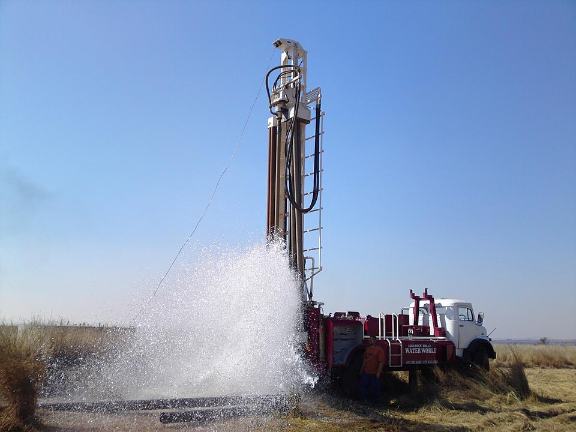
Using our heavy-duty, top-head drive air rotary rigs, we set up directly over your existing wellhead. We extract the pump, the drop pipe, and the wiring. Then, we advance a heavy pneumatic Down-The-Hole (DTH) hammer through the bottom of your existing casing. By punching 50, 100, or even 200 feet deeper into the dense volcanic basalt, we can intersect new, untapped water-bearing fractures. Once a robust new static water level is established, we lower your pump to the new appropriate depth, instantly restoring reliable volume and pressure to your home.
Structural Liner Installations
In older wells, especially those drilled decades ago, the original steel casing may begin to corrode, or the uncased bedrock walls may start to fracture and collapse. This allows shallow, contaminated surface water to infiltrate the well, or causes the borehole to fill with abrasive rock debris that buries the pump.
If deepening the well reveals unstable rock formations, we will perform a liner installation. We insert a smaller-diameter PVC or steel liner directly into the existing borehole, effectively creating a "well within a well." We then install specialized well screens and gravel packs at the intake zone, structurally securing the borehole from collapse while filtering out abrasive sediments.
Hydro-Fracking the Basalt
Sometimes, a well doesn't need to be deeper; it just needs its intake zones opened up. If you live in an area dominated by hard igneous rock (like Redmond, Sisters, or Tumalo) and suffer from chronic low yield (e.g., 1 to 3 GPM), your well may simply be intersecting tight, poorly producing rock fractures.
We utilize hydro-fracking (hydro-fracturing) to solve this. We lower a heavy-duty inflatable straddle packer deep into the well and seal off a specific section of the basalt. We then pump thousands of gallons of clean water into that isolated zone under massive, immense pressure (often exceeding 2,000 PSI). This incredible hydraulic force physically blows out accumulated mineral scale, sediment, and debris, permanently widening the microscopic fissures in the bedrock and allowing vastly more water to flow into the borehole.
Diagnostic Process: Pump Failure vs. Dry Well
A sudden drop in pressure does not automatically mean your aquifer has run dry. Before we mobilize a multi-ton drill rig to your property, we conduct a rigorous diagnostic assessment to ensure you actually need to deepen the well.
Often, a low water pressure well fix is mechanical rather than geological:
A ruptured bladder in your pressure tank will cause erratic, low-pressure spurts inside the house rather than an aquifer issue.
If you live in La Pine or Alfalfa, drawing loose pumice or sand can wear down pump impellers, reducing water lift ability.
Iron bacteria and calcium scale can blind screens over time, preventing water entry even if the aquifer is full.
Our technicians will perform amp-draw tests on your control box, check your dynamic flow rate, and use state-of-the-art down-hole video cameras to visually inspect the condition of your casing and the exact level of your static water table. We never recommend well deepening until we have empirically proven that the aquifer level has dropped.
OWRD Compliance and Permitting
Deepening a well is classified as a major alteration by the Oregon Water Resources Department (OWRD). You cannot simply have a contractor show up and start drilling.
As fully licensed and bonded well constructors, Bend Well Drilling & Repair handles all state-mandated compliance. We file the necessary alteration Start Cards, ensure your property setbacks still meet current code, and meticulously log the new geological strata encountered during the deepening process. Furthermore, any well alteration requires the installation or upgrading of the surface sanitary seal to ensure surface runoff cannot contaminate the newly accessed deep-water zones.
Serving All of Central Oregon
Do Not Wait for Your Well to Go Completely Dry
If your pump is starting to draw air, or if your system takes hours to recover after running the sprinklers, your well is already in the advanced stages of failure. With the ongoing multi-year droughts affecting Central Oregon, the demand for deepening services is exceptionally high.
Is Your Well Running Dry? Contact Us to Discuss Deepening Options
Speak directly with our hydrogeological experts today. We will evaluate your neighboring well logs, dispatch a diagnostic technician, and engineer a permanent solution to restore your property’s vital water supply.
Water Stopped Running in Bend, La Pine, or Central Oregon?
Don't wait days for water. Our emergency service trucks carry Grundfos submersible pumps, control boxes, pressure switches, and frozen pipe thawing rigs ready for immediate dispatch.
Schedule a Diagnostic Well Evaluation
Connect directly with our local Central Oregon technicians in Bend, La Pine, Redmond, Sisters & Deschutes County.